Conversation Openers That Feel Natural (Not Rehearsed)
Forget pickup lines. Here's how to start a conversation from what's actually in front of you, with example openers for coffee shops, bookstores, markets and more.
 By Mocktar 6 min read
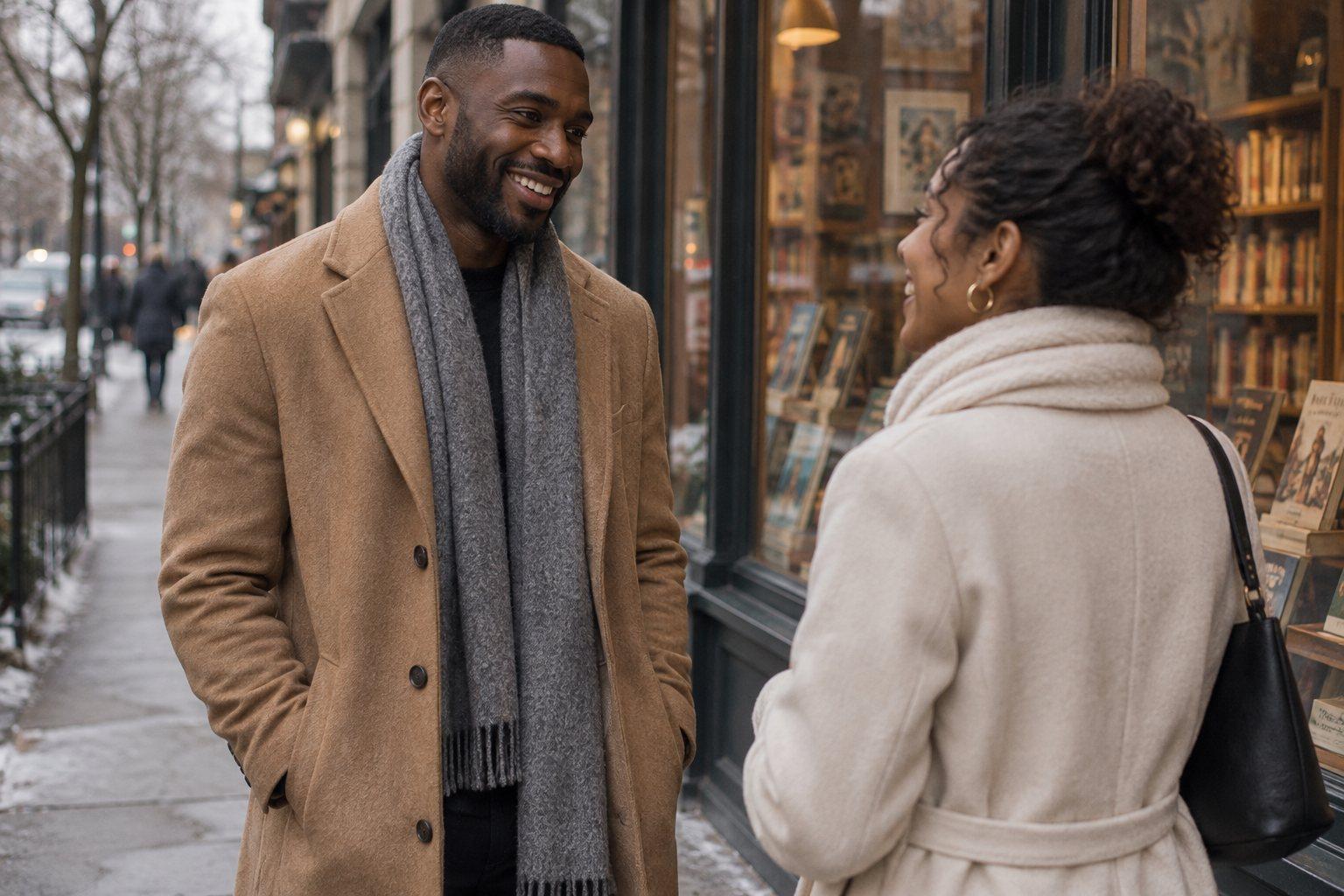
Picture a Saturday morning in a bookstore. You're holding two novels, genuinely torn, and the woman beside you is browsing the same shelf. You ask which one she'd bring on a long train ride. She has opinions. Maybe you talk for two minutes, maybe for twenty. Nothing about it is a "line"; it's a real question about a real moment. To me, that's the whole secret of natural conversation openers: notice something true, say it simply, and leave the other person plenty of room to respond, or not.
Why situational openers beat pickup lines
Pickup lines fail for a simple reason: they're about you performing, not about the two of you sharing a moment. A canned line signals that you'd have said the same thing to anyone, which is the opposite of flattering. It also puts her in an odd spot. Instead of answering a question, she has to decide how to react to a bit.
A situational opener is rooted in genuine observation of the place you're both in: the line you're standing in, the painting you're both squinting at, the dog that just stole someone's croissant. It's low-stakes, easy to answer and easy to walk away from. That last part matters. A good opener offers an easy way out as much as an easy way in.
Before you say anything, though, make sure she has room for a conversation at all. My guide on how to read the room before you approach covers the signals to look for (headphones, hurry, closed posture) and why "not now" is a perfectly good answer.
The observation + question formula
Almost every natural opener follows the same two-part structure:
- An observation: something true and specific about the situation you share.
- A question: open, easy to answer and genuinely curious.
That's it. The observation gives context, so she isn't left wondering why a stranger is talking to her, and the question hands her the turn.
What makes it work
- It's true. Don't invent a backstory to set up your question. If you're not actually picking a gift for your sister, don't say you are. Honesty is also much easier to keep going.
- It's specific. "Nice day, huh?" is fine, but "First sunny Saturday in weeks and everyone's acting like it's a holiday" gives her something to react to.
- The question is easy. Ask for an opinion or a recommendation, not personal information. "Which of these would you pick?" beats "So, where do you live?"
- It's short. One or two sentences. You're opening a door, not giving a speech.
Mocktar's note: Your tone carries more than your words. Say it the way you'd ask a friendly neighbor: relaxed, a little curious, and ready to smile and move on if she isn't in the mood.
Sincere compliments and light humor
Specific beats generic
A compliment can be a lovely opener, as long as it's specific and about a choice she made, not about her body. "You're beautiful" puts her on the spot: there's no easy reply, and she may have heard it from strangers in moments that didn't feel safe. "That's a great scarf. Did someone knit it for you?" is about her taste, and it comes with a question she can actually answer.
Good compliment targets include a book or record she picked, a bold jacket, a sharp question she asked at a talk, or the good humor she showed when the espresso machine broke down. One firm rule: don't attach a request to a compliment. A compliment that's secretly a down payment ("...so can I get your number?") isn't a compliment.
Humor that costs nobody anything
Light humor relaxes everyone, but keep it situational and kind. Laugh at the situation, or gently at yourself, never at her, her friends or anyone nearby. Teasing a stranger, "playful" insults and backhanded comments are just negging under a new name, so skip them. A simple test: if the joke would land just as well with her best friend standing right there, you're fine.
Example openers by setting
Use these as starting points, not scripts. Adapt them to what's actually in front of you, and only use one if it's true.
Bookstore
- "I keep seeing this one everywhere. Have you read it? Is it worth the hype?"
- "I'm stuck between these two. Which would you take on a long flight?"
Coffee shop line
- "I order the same thing every time. Is there anything on that menu worth being brave for?"
- "Is it just me, or does this line get longer every Saturday?"
Art gallery or museum
- "I can't decide if this piece is calm or unsettling. What do you see?"
- "Do you know anything about this artist? I'm a little out of my depth here."
Dog park
- "What's his name? He's got serious zoomies today."
- "What breed is she? She seems to be running the whole park."
Always ask before you pet someone's dog, and remember the dog is a good reason to say hello, not a prop.
Farmers market
- "Is this the stand everyone lines up for? What do you usually get?"
- "I've never cooked with these. Any idea what I should do with them?"
Events and classes
- "Is this your first class? I'm trying to figure out if I'm the only beginner."
- "That was a great question you asked. Have you been following this topic for a while?"
What to say after the opener
The opener is only the first few seconds. What turns it into a conversation is what you do next.
Bridge from the situation to the person
Follow her answer, not your script. If she says the novel is wonderful, ask what she loved about it. If she recommends the cortado, ask whether she's a regular. Then share something of your own, a small and honest detail, so it doesn't feel like an interview. Observe, ask, listen, share: that loop is most of what good conversation is.
Introduce yourself
Once there's been a real back-and-forth, offer your name: "I'm Daniel, by the way" (with your own name, of course). It's simple, it makes you a person instead of a stranger, and it invites her to share hers. If she doesn't, let it be.
Ask for contact details respectfully
If the conversation has energy (she's turned toward you, laughing, asking questions back), you can ask to continue it. Keep it simple and make declining easy:
- "I've really enjoyed talking with you. Would you want to swap numbers, or are you good?"
- "I'd love to continue this over coffee sometime. Would you be up for that?"
Another respectful option is to offer your number instead, so the choice stays entirely with her. If she says yes, follow up within a day or two with a specific, easy plan; my list of first date ideas that spark conversation can help.
Accept the answer, whatever it is
Whether it's "no," "I'm seeing someone" or a hesitant "um, maybe," your response is the same: "No problem at all. Really nice talking with you." Then go. No asking twice, no negotiating, no "why not?" A gracious exit leaves her with a good memory of a stranger, and that matters more than the outcome.
The takeaway
- Open with what's real: a true observation about the moment you share, plus an easy question.
- Compliment choices, not bodies, and never attach a request to a compliment.
- Keep humor kind and situational: aim it at the moment or yourself, never at her.
- Bridge by listening: follow her answer, share a little, then introduce yourself.
- Ask once, make "no" easy, and accept the answer with genuine grace.
Frequently asked questions
What's a good first thing to say to someone I don't know?
Something true about the situation you share, followed by an easy question. "This line gets longer every Saturday. Is the cold brew worth the wait?" works because it's real, low-pressure and simple to answer.
Should I open with a compliment?
You can, if it's specific and about a choice she made: a book, a jacket, a sharp question she asked at a talk. Skip compliments about her body, and never attach a request to a compliment.
What do I say after the opener?
Follow her answer, not your script. Ask about what she just said, share a small honest detail of your own, and introduce yourself once there's been a real back-and-forth.
How do I ask for her number without being pushy?
Ask once, simply, and make it easy to decline: "I've enjoyed this. Would you want to swap numbers, or are you good?" Whatever she answers, thank her and mean it.

About the author
Mocktar
Mocktar writes about confidence, style and genuine connection: dating advice built on respect, honesty and a little charm.
More about MocktarKeep reading
Approach & OpenersHow to Read the Room Before You Approach Someone
Before any opener comes the read. Here's how to check body language, timing and context so your approach feels welcome, and how to exit gracefully when it isn't.
 Attraction Psychology
How Vulnerability Builds Genuine Connection in Dating
A polished performance impresses for a minute; honesty connects for much longer. Here's how to open up at the right pace, listen well and know when someone isn't your person.
 Texting & Online Dating
Texting From Match to First Date Without Overdoing It
You matched. Now what? Here's how to text with warmth and intention, from a first message that proves you read her profile to a date plan she's glad to say yes to.